Monday, February 24, 2014

Modica (February 21)

After some lunch in Ragusa, we loaded the kids back on the bus and traveled to a neighboring town along the Iblea mountain range called Módica.  Francesca and Barbara followed us over there and continued with their thoughtful guidance through the town.  Like Ragusa, Módica also was flattened by the earthquake of 1693 and rebuilt thereafter in Baroque-style fashion.

Our first attraction was the duomo of Módica, called San Giorgio-Mater Ecclesiae.  It is situated at the top of the town which, like Ragusa, is carved out of the hills of mountains of Iblea.  So we had a bit of hike upwards from the bus to get there.  The church was closed but the one of the priests let us in for about 10 minutes to view the inside.  Again, the interior was gorgeous, especially the altar, comprised of 10 panels depicting scenes of the Holy Family from the birth of Jesus through to his ascension into Heaven.

Módica is also known for being the home of Salvatore Quasimodo, one of Italy’s four Nobel Prize winners for literature (1959).  The plaque is located just outside his childhood home. Quasimodo was a poet and wrote such works as "Day After Day", "Life is Not a Dream", and "The Incomparable Land," which have a satirical slant on the post World War II world.
 ciocolate perperoncino, a spicy chocolate.  While many of these original chocolate recipes did not survive in America, they thrived and were perfected in Sicily.  In fact, many Italians admit that Italy was not the inventors of much over the centuries.  “We take inventions and perfect them,” as many of the Viterbese folk I’ve spoken to declare proudly.
Módica
Módica is also known for its contributions to the making and spreading of the chocolate phenomenon over the centuries.  For a time, Sicily was under Spanish rule.  Often Spanish explorers would bring back material goods from the New World but they also would bring back recipes of foods they had experienced from the natives. One such recipe was

While in Módica, we were privy to experience the chocolate of Antica Dolceria Bonajuto, both a chocolate store and factory.  We enjoyed tasting different kinds of chocolate ranging from 100% pure dark chocolate (no sweetners of any kind…very bitter) to sweeten chocolate with cinnamon, perperoncino, lemon, salt, and bits of orange.  Afterwards, we were directed toward the factory and given a demonstration of how the chocolate is made.  In the picture you see what looks like small licorice-like orange pieces, which they either insert into the chocolate or form into small orange rings.  As you can see, we had to dress in white smocks from head to toe in order to enter the factory.  I felt like Mike-TV on Willy Wonka and the Chocolate Factory! 

In the end the chocolate got the best of me and I ordered several bars of the cinnamon chocolate.  Unbelievably good!  Now that we were all in choco-comma, we waddled our way back onto the bus and headed back to our hotel in Taormina for dinner (really??) and then some much-needed rest!

Ragusa (February 21)

It was a beautiful day in Ragusa, a small town in the southern part of Sicily, probably the nicest day we’ve had on the trip.  After debarking the bus and hiking up a small hill, we arrived at La Piazza San Giorgio.  We met up with our two tour guides, Barbara and Francesca.  The kids were divided up into two groups and each group had their own guide. Ours was Francesca, a very energetic woman, and her bright yellow jacket only accentuated this point.

My first observation of the town was the absence of people.  I noticed this same phenomenon in Taormina the day before.  So where are all the people?  Are they on holiday? Have we walked into some ghost town that has been perfectly preserved?  As Jerry Seinfeld would say, “what’s the deal?”

As one of the SYA Italian teachers said in jest, “Ragusa….where the men are aristocratically sublime while the women are home baking and the children are at school.”  In Ragusa’s defense, it’s not a huge tourist attraction and it was a Friday morning, not a point in the week where there would be a lot of people milling about in the streets.  That said, Ragusa was one of the cleanest towns I’ve seen in Italy.

Here are some facts about Ragusa. It has two patron saints, San Giuseppe and San Giorgio.  The whole town was flattened by an earthquake in 1693.  The only surviving piece of the old town was the portal to the church of San Giuseppi (see left).  As a result the entire city was rebuilt and moved to its current location.  All of the major fortresses were built during the Barroque period.  The exterior of the duomo of San Giorgio (see left)  is a good illustration of this style architecture.  While Mount Etna is visible from Ragusa, this town actually sits on the edge of another mountain range called Iblea.  Ragusa is also credited for inventing ravioli and is also well known for their gnocci.

Francesca, our guide, was great.  Aside from maintaining an authentic smile on her face the whole time, she was extremely knowledgeable about the area and she was very patient with our kids throughout.  One of her many teachable moments was to distinguish for the kids the difference between a chiesa and a duomo.  While any town in Italy has numerous churches, there is usually only one duomo.  I say “usually” because Ragusa actually has two duomos.  The duomo of a town is considered the main church.  A duomo can be a cathedral if there is a sitting bishop of the town.  This picture is the interior of one of the Duomos, San Giorgio, named after Giorgio, the Roman warrior of his time.  The second picture shows one of The Stations of the Cross inside San Giorgio, probably one of the most beautiful sets of The Stations I’ve seen in Italy.  The third picture (below) shows the altar of San Giorgio.

The other duomo, San Giuseppi (pictured at the right, was not opened however Francesca explained the interesting markings just to the right of the entryway.  The markings illustrate an Islamic way of telling time, indicating the once Islamic influence within the region.  If you look blown-up picture below, there is a nail through the 24-hour line.  The 24-hour line indicates sunset.  Given the placement on the sun, it casts a shadow of the nail on the wall, which intersects the other hour lines from hour 18 through 24.  The length of the line from the 24-hour line indicates the amount of sunlight left in the day.  In the picture below, the shadow of the nail is touching the 20-hour line, which would mean that sunset will occur in approximately four hours from the current time.  I’m not sure of the accuracy, given that this picture was taken at around 1 in the afternoon, but the concept still is pretty interesting!

Sunday, February 23, 2014

Taormina (February 20)

We left Catania around 11:30 and arrived in Taormina about an hour later.  The drive into Taormina was amazing!  It’s very much a tourist attraction because of its location right along the Mediterranean Sea and Mount Etna.  Here are just a couple of pictures that illustrate my point and they don’t really do it justice.  The day was mostly overcast, so much so that Mount Etna wasn’t visible at all.  Below is the view of Mt. Etna we would have seen had the weather been more coorperative!

We enjoyed a quick bag lunch we purchased while in Catania and then we entered the Greco-Roman theater.  Initially built in 150 B.C. (and enhanced/built up through the second century A.D.), the theater is beautifully situated on a hill well above the shoreline of Taormina.  The circular shape of the theater made for good acoustics back then, since there was no such thing as microphones!  One of the reasons the inhabitants picked this spot was because it was easy for them to use the natural terrain as the frame that would become the main level of the theater.

While in the theater, selected students performed excerpts from both a typical comedy and tragedy.  The comedy of choice was Aristophanes Clouds, a cheeky play that makes fun of Socrates, and the tragedy was Euripedes’, Medea, which depicts a mother’s slaying of her own children as a spiteful revenge against her ex-husband for divorcing her for another woman.  I was privileged enough to play the role of Child #1 and offered up a very dramatic interpretation of how he died. In the picture left you see Reggie and Brianna acting out a scene in Clouds, where Reggie portrayed a very clueless Socrates while Brianna played Socrates’ very snarky friend, Strepsades. 

After our very loose interpretations of Greek tragedy/comedy, the students (with some prompting by Yvonne, see right) took us through an archaeological account of how the theater was built and the various examples of symmetry, the golden ratio, and acoustic perfection were incorporated in the design of the theater.

Afterwards, the students had 3 and half hours of free time to explore Taormina.  Many of us, me included, took a hike up a cliff even higher than where the Roman theater was to a Monastery, Madonna della Rocca.  At the ends of each switchback on the path to the Monastery were bronzed Stations of the Cross (see left).  Farther up the path, was an abandoned fort (see right) which at one time was used to defend the area from Norman rule in the 9th  through 12th centuries.  The hike was great but we were disappointed to find that it was closed to the public once we arrived.  L

Our very last site was La Isla Bella (see left/right), just a beautiful island with a house perched on top of it just a few meters of the coast of Taormina.  Not a bad place “get-away” place, right?

Catania (February 20)

About 7:30 p.m. we boarded the Trinacria, a “small” cruise liner that took us from Napoli to a place called Catania. I call it “small” because the liner was smaller than vacation cruise liner like Caribbean or Carnival but big enough to hold 18-wheelers and busses.  Our trip across the Strait of Messina took about 12 hours and it was very pleasant.  The rooms were clean, the beds comfortable (the sway of the ship rocked me to sleep), and the shower in the bathroom was amazing!  Immediate warm water and great pressure!  Ah, the little things…..

Our main purpose for being in Catania was to get our land legs again.  We had no academic agenda in Catania.  Thus, we had some free time wander around the center of town.  Other than a port for receiving tourists, Catania is not really a tourist attraction.  Usually people get off the ship and scurry elsewhere.  However, I found Catania to be quite pleasant and inviting.  After a 20-minute walk from the ship, we made it to Piazza di Duomo, a beautiful square that includes a fountain displaying its mascot, an elephant called Elotru, and the Duomo of Catania, called Sant’ Agata (St. Agatha), patron saint of breast cancer.


The interior of Sant’ Agata is set up pretty traditionally, with two sets of pews, a main aisle up the middle with aisles on either side.  The alter was completely hidden behind a construction tapestry but through the cracks you could tell there were some amazing stained glass windows that surround it.  Along the outside aisles were some beautiful paintings depicting certain bible scenes or Jesus Christ or Mother Mary (or of both as in the picture shown), with side altars or small chapels for which to be in silent prayer or adoration.

Just off the piazza we were witness to a daily occurrence in Catania: the live fish market!  I call it “live” because some of the merchants were selling fish that were literally jumping out of the buckets, in particular eels and anchovies.  But as you can see in the picture, all kinds of sea creatures were for sale, including bass, shrimp, swordfish, and squid….all fresh of course!

Saturday, February 22, 2014

Napoli (February 19)

We arrived in Napoli abound 4 in the afternoon and we had about three and half hours to kill before boarding our ferry to Sicily.  Fabrizzio, our bus driver dropped us off in the heart of town, very close to the square you see here (left), called Piazza del Plebescito.  Quite frankly, I was pleasantly surprised to see how beautiful Napoli was from this vantage point.  I was very underwhelmed by it the first time I visited in 2011 with the Running Through History tour.  Perhaps that part of town, which was near the train station, is better known for its crime, defamation of its buildings with graffiti and general grime!  However, near the Piazza del Plebescito, it was fairly clean, safe, and with a vibrant social scene and economy.

Napoli is credited for inventing pizza and in general it has a very good reputation for having some of the best pizza in all of Italy.  So while it was 4 in the afternoon and I usually don’t eat at this time of day, I had to see what all the fuss was about!  Yvonne, Richard, and I found a pizza place off the main piazza and ordered a slice.  One main distinction between Napolese and Viterbese pizzas is that the bread is thicker in Napolese pizza than the pizza in Viterbo.  A second distinction, which is related to the first, is the water they use to make the dough.  The water in Viterbo is considered to be much harder than the water
in Napoli, which apparently stunts the dough’s ability to rise.  That’s part of the reason why the crust on pizza in Viterbo is so thin.    In the end, the pizza was good, but I think I still prefer Viterbese pizza!

Afterwards, we met up with Brad and Danielle outside a typical pastry shop, this one was called Las Frogliatera Mary.  Again, while in Napoli we had to taste a typical Napolese pastry. Yvonne, Danielle and Brad got a rischia, which looked like a croissant, while I tried a frolla, which looked like a dinner roll.  In both cases the warmed pastries were filled with ricotta and orange peel bits fused in orange flour essence.    Simply unbelievable and certainly nothing that exists in Viterbo.  Wow!

After our afternoon of decadence, we waddled back to our bus and where it would take us to our ferry for our voyage across the Strait of Messina to Sicily!  Here's us doing just that!

Herculaneum (February 19)

Today was the first day of our nine-day school trip to Sicily!  From Viterbo, we would take a bus to Napoli, where a ferry would take us over to our first Sicilian destination, Catania.

On our way to Napoli, we first stopped in Herculaneum, a neighboring town to Pompeii, which also succumbed to the cataclysmic eruption of Mount Vesuvius on that fateful day in August, 79 A.D.  While not the tourist attraction of
Pompeii, Hurculaneum also was once under 9+ feet of volcanic ash and lava.  It’s not a fully excavated as Pompeii but as a result it makes for a more intimate (more manageable) tour through the ruins.  Like Pompeii, it is amazing that at one time all of what we saw was completely buried. 

In this picture, to the left are boat houses and where the grass is located below was once a river where merchants brought in their fishing boats for commerce.  The well-to-do had apartments above the boat houses that overlooked the picturesque views of the river.  Here is a picture (right) of a typical fishing boat, albeit severely charred from the intense heat from the eruption.


As we toured Herculaneum, students made presentations about how the eruption occurred (see left), a typical day for merchants or students at the local college, and how the well-to-do use to entertain their guests in their luxurious mansions. Here is a very well-preserved mosaic (below right) found in one of the highlighted mansions on our tour.  Amazing!!

Yvonne taking a moment to relax. Ahh!
The day was pretty cloudy and overcast but thankfully it did not rain on us.  There was a very brief moment in the day when the clouds thinned just enough for me to take this picture of Mount Vesuvius in the background.  While truncated today, the mountain once had an apex prior to the eruption of 79 A.D. 

Rome Day Trip - Vatican (February 7)

Today we embarked on the fourth and final trip to Rome.  Over four trips, students were exposed to the Coluseum-Palentine-Roman Forum (led by Santo Sammartino), Rome as a movie set (led by Daniele Gatti), the Catacombs of Sant’ Agnese-Tomb of Santa Costanza-Crypt of the Cappucini Monks (led by Brad Park) and lastly (but certainly not leastly) Il Vaticano (led by Yvonne Mazurek). All of the trips were great but I was really looking forward to Yvonne leading us through the Vatican Museum and the Basilica of St. Peter.  Her knowledge of the Vatican Museum, in particular, was immense.
In this picture, Yvonne is discussing this altarpiece, a triptych by Giotto, featuring St. Peter (on throne with the two keys) surrounded by four other saints, including Andrew, John, James the Elder and Paul.

Part of our tour of the Vatican Museum included a long room called the Hall of Maps, a room full of maps of different regions of Italy, all tapestries stitched in the 16th century. Here’s a tapestry of the province of Lazio.  In the lower left-hand corner is an insert of the medieval part of Viterbo, the capital of the region (within Lazio) also known as Viterbo.  Most of the tapestries do not have this insert but Viterbo has this honor because of its connection to housing the papacy during the 13th century.

Next, we entered the Pinectoteca, a.k.a. the painting gallery.  Here’s a painting of the transfiguration of Jesus Christ (Rafaello and Giulio Romano).  This was Rafaello’s very last painting before his death.  In fact, he did not finish it so Romano, his apprentice, did.  The bottom half is Romano’s “response to his master’s section,” as Yvonne put it.  She used the word, “response”, to illustrate the contrast in styles between Rafaello and Romano.

Here's is a painting of St. Peter being crucified upside down (by Guido Reni).  While a disciple of Jesus Christ, Peter didn't see himself worthy of being crucified in the same manner as his teacher.  So as a last request, he asked to be turned upside down on the cross. 

Next, it was off to the Sistine Chapel.  Fortunately it was a sunny day, as the chapel is naturally lit to help preserve Michelangelo’s masterpiece on its ceiling.  Because we went on a Thursday in early February, the crowds were not huge.  This was especially noticeable in the Sistine Chapel.  People, in general, were very cooperative and respectful of the space and actually did little speaking while in there.  Yvonne and I actually were able to find seats along the wall in the  sanctuary.

Lastly, we were led to the Basilica of St. Peter, an enormous church that could overwhelm anyone but I found a serenity come over me as I entered it. The Pietá, on the right as you enter from the back, is an obvious attraction for many tourists and for good reason.  Michelangelo is a master at capturing the essence of Mary’s final moments with Jesus upon his dissention from the cross.

Also in the back of the church are St. Peter's silver and gold keys to the Kingdom (above right), which were given to him by Jesus Christ.  One of the keys opens the gates of Heaven while the other key represents terrestrial power, as stated in Matthew 16:19. "Whatever you bind on earth shall be bound in Heaven, and whatever you loose on earth shall be loosed in Heaven."  It's a metaphorical offering of Jesus Christ to St. Peter that he has in his care the teachings of God and, in essence, the care of the Church in his hands.  The keys are then to be passed down to each descendant
 of the papacy thereafter.  Upon the death of a Pope, a symbolic set of these keys is buried with him, a tradition began back in the 16th century.
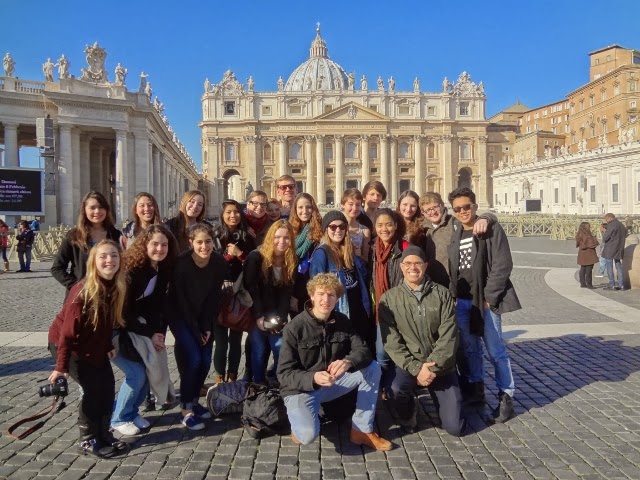
Front: Aiden and Me
Middle:  Corynne, Marlaina, Emma, Liddy, Rhyan, Rachel, Nick and Akbar
Back: Arielle, Casey, Siena, Thea, Yvonne, Savannah (Brad's daughter), Brad, Victoria, Izzy, Ethan and Quincy